Maximize Your Savings: Understanding 2026 Dependent Care Benefits

Anúncios
In an ever-evolving economic landscape, understanding and leveraging available financial benefits is crucial for family stability and growth. For many households, the cost of caring for dependents—whether young children or elderly relatives—represents a significant portion of their annual budget. As we look ahead to 2026, there are important updates and considerations regarding dependent care benefits 2026 that could profoundly impact your financial planning. This comprehensive guide aims to demystify these benefits, highlight potential savings, and equip you with the knowledge to make informed decisions.
The federal government, through various tax provisions, offers avenues for families to reduce the burden of dependent care costs. These benefits are not merely a small deduction; they can translate into substantial savings, potentially up to $5,000 annually for eligible families. Navigating the intricacies of these programs, however, requires a clear understanding of eligibility criteria, contribution limits, and the interplay between different benefit types. Our focus here will be on providing a detailed roadmap to help you maximize your dependent care benefits 2026.
Anúncios
What Are Dependent Care Benefits?
Dependent care benefits are provisions designed to assist taxpayers with the costs associated with caring for a qualifying dependent while the taxpayer (and their spouse, if filing jointly) works or actively looks for work. These benefits primarily come in two forms: the Dependent Care Flexible Spending Account (DCFSA) and the Child and Dependent Care Credit (CDCC). While both aim to alleviate the financial strain of caregiving, they operate differently and offer distinct advantages.
The Dependent Care Flexible Spending Account (DCFSA)
A DCFSA is an employer-sponsored benefit that allows you to set aside pre-tax money from your paycheck to pay for eligible dependent care expenses. The key advantage here is the tax savings: the money you contribute to a DCFSA is not subject to federal income tax, Social Security tax, or Medicare tax. This means you’re paying for care with money that hasn’t been taxed yet, effectively increasing your take-home pay.
For 2026, while specific limits are subject to inflation adjustments, the general framework of the DCFSA is expected to remain similar. Typically, the maximum amount you can contribute to a DCFSA is $5,000 per household per year (or $2,500 if married filing separately). This $5,000 limit applies regardless of the number of dependents you have. It’s important to note that DCFSAs operate on a “use-it-or-lose-it” basis, meaning any funds not used by the end of the plan year (with some grace period exceptions) are forfeited. Therefore, careful planning of your contributions is essential.
The Child and Dependent Care Credit (CDCC)
The CDCC is a non-refundable tax credit that allows you to reduce your tax liability dollar-for-dollar based on a percentage of your eligible dependent care expenses. Unlike the DCFSA, which is a pre-tax deduction, the CDCC is claimed when you file your tax return. The amount of the credit depends on your Adjusted Gross Income (AGI) and the amount of qualifying expenses. The maximum amount of expenses that can be used to calculate the credit is $3,000 for one qualifying individual and $6,000 for two or more qualifying individuals.
The percentage of expenses you can claim as a credit ranges from 20% to 35%, with higher percentages for lower AGIs. For example, if your AGI is below a certain threshold, you might qualify for the maximum 35% credit. As your AGI increases, the percentage decreases, eventually bottoming out at 20% for higher-income taxpayers. It’s crucial to understand that you generally cannot “double-dip” by using the same expenses for both a DCFSA and the CDCC. You must choose which benefit provides the greatest advantage for your specific situation.
Eligibility Requirements for 2026 Dependent Care Benefits
To qualify for either the DCFSA or the CDCC, both the dependent and the care provider must meet specific criteria. Understanding these requirements is the first step in unlocking your dependent care benefits 2026.
Who is a Qualifying Dependent?
For the purposes of dependent care benefits, a “qualifying individual” typically includes:
- A child under the age of 13 who is your dependent.
- A spouse who is physically or mentally incapable of self-care and lives with you for more than half the year.
- Any other individual who is physically or mentally incapable of self-care, lives with you for more than half the year, and is your dependent.
The key here is the inability to self-care for adults and the age limit for children. For children, the care must be necessary for them to be able to live with you while you work or look for work. For adults, the care must be provided in a way that allows you to be gainfully employed.
What are Qualifying Expenses?
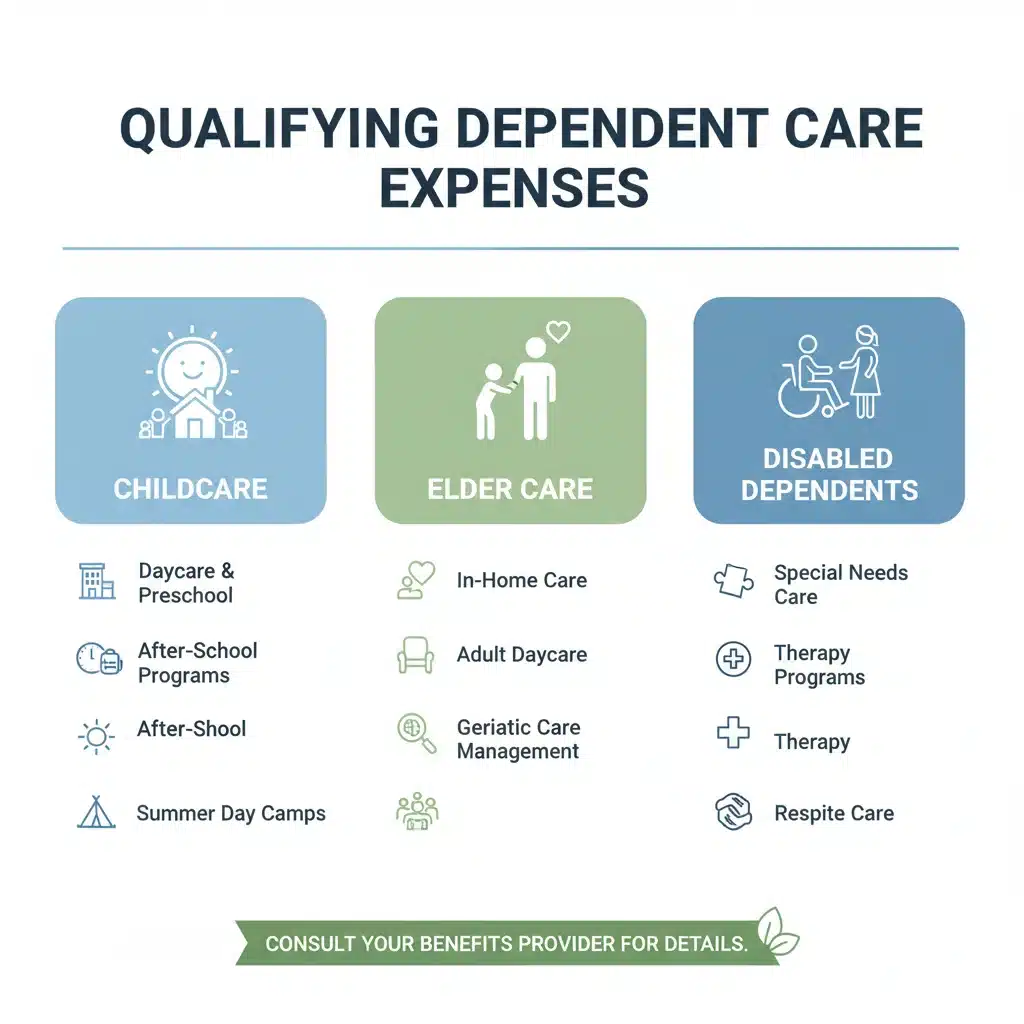
Eligible expenses are those incurred for the care of a qualifying individual that enable you (and your spouse, if applicable) to work or look for work. This means the primary purpose of the care must be for the well-being and protection of the qualifying individual. Common qualifying expenses include:
- Daycare expenses: Fees paid to licensed daycare centers or family daycare homes.
- Nursery school or preschool: Costs associated with educational programs for young children, but only if the primary purpose is care, not education.
- After-school programs: Fees for programs that care for children after regular school hours.
- In-home care: Wages paid to nannies, babysitters, or au pairs, but only for the portion of their time spent on caregiving duties. Household services may also qualify if they are partly for the care of the qualifying individual.
- Summer day camps: Costs for day camps (not overnight camps) where the primary purpose is care.
- Elder care: Expenses for adult daycare centers or in-home care for a qualifying adult who is incapable of self-care.
Expenses that generally do NOT qualify include tuition for kindergarten or higher grades, overnight camps, or care provided by your spouse or a child under age 19. Always keep detailed records and receipts for all dependent care expenses.
Maximizing Your Savings: DCFSA vs. CDCC
Choosing between the DCFSA and the CDCC, or understanding how they can interact, is critical for maximizing your dependent care benefits 2026. The decision often depends on your income level, the amount of your dependent care expenses, and your tax bracket.
When DCFSA is More Advantageous
The DCFSA is often more beneficial for higher-income earners. The pre-tax contributions reduce your taxable income, which can lead to significant savings on federal income tax, Social Security, and Medicare taxes. For someone in a higher tax bracket, the immediate tax savings from a DCFSA can outweigh the value of the CDCC.
Consider a scenario where a family has $5,000 in eligible dependent care expenses. If they contribute $5,000 to a DCFSA and are in a combined federal and state tax bracket of, say, 25% (plus FICA taxes of 7.65%), their total tax savings could be around $1,632.50 ($5,000 * (0.25 + 0.0765)). This is a direct reduction in their tax burden before they even file their return.
When CDCC is More Advantageous
The CDCC tends to be more advantageous for lower-to-middle-income families. Because the credit percentage is higher for lower AGIs, these families can see a more substantial tax reduction from the credit. If your AGI is low enough to qualify for the maximum 35% credit, and you have $3,000 in qualifying expenses for one dependent, you could receive a $1,050 credit ($3,000 * 0.35).
It’s also important to remember that the CDCC is a credit, meaning it directly reduces your tax liability. If you have very low income and little tax liability, a non-refundable credit might not be as beneficial as a pre-tax deduction if you don’t have enough tax to offset.
Combining the Benefits (Partial Use)
While you cannot use the same dollar of expense for both benefits, you can sometimes use both if your expenses exceed the DCFSA limit. For example, if you have $7,000 in eligible expenses for two children, you could contribute $5,000 to a DCFSA. The remaining $2,000 in expenses could then be used towards calculating your CDCC. Since the CDCC allows up to $6,000 in expenses for two or more dependents, using $2,000 from the remaining pool would still leave you with a potential credit. This strategy requires careful calculation to ensure you’re maximizing every dollar.
Always perform a “cost-benefit analysis” or consult with a tax professional to determine the optimal strategy for your household. Tax software can also help you compare the outcomes of using one benefit over the other, or a combination thereof, to find the most advantageous approach for your dependent care benefits 2026.
Impact of Potential Legislative Changes on 2026 Dependent Care Benefits
Tax laws are subject to change, and while the core framework of dependent care benefits has been relatively stable, specific limits and provisions can be adjusted by Congress. As we approach 2026, it’s prudent to consider how potential legislative changes might influence these benefits.
Inflation Adjustments
The most common adjustments to tax benefits are annual inflation adjustments. The $5,000 DCFSA limit and the expense limits for the CDCC ($3,000 for one dependent, $6,000 for two or more) have been static for a while. However, there’s always the possibility of these limits being indexed for inflation or adjusted upwards to better reflect the rising costs of childcare and elder care. Staying informed about IRS announcements and legislative updates will be key to understanding the precise figures for dependent care benefits 2026.
Broader Tax Reform Initiatives
The political landscape can lead to broader tax reform discussions. Depending on the administration and congressional priorities, there could be proposals to enhance, modify, or even reduce certain tax benefits. For dependent care, this could mean:
- Increased limits: A push to increase the DCFSA contribution limit or the CDCC expense limits to provide more relief to families.
- Refundability of the CDCC: Making the Child and Dependent Care Credit refundable could significantly benefit lower-income families who might not have enough tax liability to fully utilize a non-refundable credit. This was temporarily seen during the pandemic, and there’s always a possibility of it being reinstated.
- Changes to eligibility: Modifications to the definitions of “qualifying individual” or “eligible expenses.”
- New programs: Introduction of entirely new programs or subsidies aimed at supporting working families with care costs.
While speculation is difficult, staying attuned to policy debates and proposals will help you anticipate potential changes that could affect your financial planning for dependent care benefits 2026. Reputable financial news outlets and government websites are the best sources for official updates.
Practical Steps to Plan for 2026 Dependent Care Benefits
Effective planning is crucial to fully leverage dependent care benefits 2026. Here are actionable steps you can take:
1. Assess Your Current and Projected Dependent Care Costs
Start by itemizing all your current dependent care expenses. Consider costs for daycare, after-school programs, nannies, elder care, and summer camps. Project these costs into 2026, accounting for any expected increases. Having a clear picture of your annual expenditures will help you determine how much to contribute to a DCFSA or how much to claim for the CDCC.
2. Understand Your Employer’s Benefits
If your employer offers a DCFSA, familiarize yourself with their specific plan rules. Understand the enrollment periods, contribution limits, and any grace periods for using funds. If you have the option, learn about how to enroll and make changes to your contributions.
3. Compare DCFSA vs. CDCC Based on Your Income
As discussed, your Adjusted Gross Income (AGI) is a significant factor in determining which benefit is more advantageous. Use online tax calculators or consult with a tax professional to run scenarios. Compare the estimated tax savings from a DCFSA (considering your tax bracket) against the potential credit from the CDCC. Remember to factor in FICA tax savings with the DCFSA.
4. Keep Meticulous Records
For both benefits, accurate record-keeping is non-negotiable. Maintain receipts, invoices, and payment records from your care providers. For the CDCC, you’ll need the care provider’s name, address, and Taxpayer Identification Number (TIN) or Social Security Number (SSN). If you use a DCFSA, these records will be essential for reimbursement.
5. Adjust Contributions Annually
Life circumstances change, and so do dependent care needs. Review your DCFSA contributions during your employer’s open enrollment period each year. If you experience a qualifying life event (e.g., birth of a child, change in marital status, change in care costs), you may be able to adjust your contributions mid-year.
6. Stay Informed About Tax Law Changes
Subscribe to IRS updates, follow reputable financial news sources, and periodically check government websites for any announcements regarding tax law changes that could impact dependent care benefits 2026. Being proactive in gathering information will ensure you’re always making the most informed decisions.

Common Pitfalls to Avoid
While dependent care benefits 2026 offer significant savings, there are common mistakes that can lead to missed opportunities or even tax issues. Being aware of these can help you navigate the system more smoothly.
Over-contributing to a DCFSA
The “use-it-or-lose-it” rule for DCFSAs is a major consideration. If you contribute more than you end up spending on eligible expenses, you forfeit the unused funds. This highlights the importance of carefully estimating your care costs for the year. If your care needs are unpredictable, or if you anticipate significant changes, a lower DCFSA contribution coupled with relying more on the CDCC might be a safer strategy.
Not Understanding Eligibility for Care Providers
Not all care providers qualify. For example, you cannot claim expenses paid to your spouse, your child under age 19, or a dependent you claim on your tax return. Ensure your care provider is legally permitted to work and, if required, provides you with their Taxpayer Identification Number (TIN) or Social Security Number (SSN) for tax purposes. Failure to do so can result in the disallowance of your benefits.
Ignoring the “Work-Related” Test
The care expenses must be incurred to allow you (and your spouse, if applicable) to work or look for work. If one spouse is a stay-at-home parent, for instance, generally the expenses won’t qualify unless the stay-at-home spouse is a full-time student or physically/mentally incapable of self-care. Always ensure the care is “work-related” according to IRS guidelines.
Failing to Keep Proper Records
The IRS requires documentation to support your claims for dependent care benefits. Without proper records, including receipts and the care provider’s information, your claims could be denied during an audit. Develop a system for organizing these documents throughout the year.
Not Re-evaluating Annually
Your financial situation, care needs, and tax laws can change from year to year. What was the best strategy for your dependent care benefits this year might not be optimal for 2026. Make it a point to re-evaluate your options during open enrollment periods and before filing your taxes each year.
The Long-Term Financial Impact of Dependent Care Benefits
Beyond the immediate tax savings, effectively utilizing dependent care benefits 2026 can have significant long-term financial implications. By reducing your taxable income and direct tax liability, you’re essentially freeing up more of your earnings. This extra capital can be strategically allocated to various financial goals.
Increased Savings and Investments
The money saved through dependent care benefits can be channeled into personal savings accounts, emergency funds, or investment vehicles. Building a robust emergency fund is crucial for financial resilience, while consistent investing can contribute significantly to long-term wealth accumulation for retirement, education, or other major life events. Even small, consistent contributions can grow substantially over time due to the power of compounding.
Debt Reduction
For families carrying high-interest debt, such as credit card balances or personal loans, the additional funds from dependent care savings can be used to accelerate debt repayment. Reducing debt not only lowers your monthly financial burden but also improves your credit score and overall financial health, creating more flexibility for future financial decisions.
Enhanced Budgeting Flexibility
When dependent care costs are partially offset by tax benefits, it alleviates pressure on your monthly budget. This enhanced flexibility can allow you to allocate funds to other essential categories, such as housing, food, transportation, or educational expenses. It can also provide a buffer for unexpected costs, reducing financial stress and contributing to a better quality of life.
Workforce Participation and Career Growth
For many parents and caregivers, the high cost of dependent care is a significant barrier to workforce participation or career advancement. By making care more affordable, these benefits indirectly support individuals in maintaining employment, pursuing further education, or taking on more demanding roles. This sustained workforce participation can lead to higher lifetime earnings and greater financial security for the entire family, underscoring the broader societal and personal benefits of dependent care benefits 2026.
Conclusion
The landscape of dependent care is complex and costly, but the availability of dependent care benefits 2026 offers a powerful tool for families to manage these expenses more effectively. By understanding the nuances of the Dependent Care Flexible Spending Account (DCFSA) and the Child and Dependent Care Credit (CDCC), assessing your eligibility, and meticulously planning your approach, you can unlock significant savings—potentially up to $5,000 annually.
Remember that careful record-keeping, annual re-evaluation of your financial situation, and staying informed about potential legislative changes are paramount. Whether you choose to leverage a DCFSA, the CDCC, or a strategic combination of both, the goal remains the same: to reduce your tax burden, free up valuable financial resources, and support your family’s well-being. Proactive engagement with these benefits is not just about saving money; it’s about building a more secure and stable financial future for your loved ones.