SECURE 2.0 Act: Boost Your Retirement Savings in 2026

Anúncios
In the ever-evolving landscape of financial planning, staying informed about legislative changes is paramount, especially when it comes to securing your future. The SECURE 2.0 Act, building upon its predecessor, is set to usher in a new era of retirement savings opportunities, with significant updates taking effect in 2026. These changes are designed to enhance your ability to save for retirement, offering potential boosts to your 401(k) and IRA accounts by as much as 15%. Understanding these modifications and strategically adapting your financial plan can make a substantial difference in your long-term financial security. This comprehensive guide will delve into the critical aspects of the SECURE 2.0 Act, outlining how its provisions will impact your retirement benefits and providing actionable insights to maximize your savings.
Anúncios
The Latest in Retirement Benefits: How SECURE 2.0 Act Updates Impact Your 401(k) and IRA in 2026, Boosting Savings by Up to 15%
For many, retirement seems like a distant goal, but the decisions made today profoundly influence the quality of life enjoyed tomorrow. The original SECURE Act (Setting Every Community Up for Retirement Enhancement) of 2019 introduced pivotal changes aimed at increasing access to tax-advantaged retirement accounts and preventing older Americans from outliving their savings. Now, the SECURE 2.0 Act takes these efforts a significant step further, introducing a suite of provisions that will refine and expand these opportunities, particularly coming into full effect in 2026. These updates are not merely minor adjustments; they represent a concerted effort to fortify the retirement prospects of millions, offering avenues to potentially boost your retirement savings by a considerable margin.
Our focus here is on empowering you with the knowledge to navigate these changes effectively. We will explore the nuances of the SECURE 2.0 Act, highlighting key provisions that directly affect your 401(k) and IRA. From enhanced catch-up contributions to new withdrawal flexibilities and expanded automatic enrollment features, each element plays a role in shaping your retirement landscape. By grasping these details, you can adjust your saving and investment strategies to harness the full potential of these legislative updates, ensuring your retirement fund grows robustly and resiliently.
Understanding the Core Philosophy Behind the SECURE 2.0 Act
The fundamental objective of the SECURE 2.0 Act is two-fold: to simplify and expand access to retirement savings plans and to provide greater flexibility for individuals as they approach and enter retirement. This legislation recognizes the evolving nature of the workforce, the challenges posed by inflation, and the need for more adaptable retirement solutions. It aims to address gaps in the current system, encourage greater participation in retirement plans, and offer stronger protections for accumulated savings. The act builds on the foundation of the original SECURE Act, which successfully extended the age for required minimum distributions (RMDs) and made it easier for small businesses to offer retirement plans. The SECURE 2.0 Act continues this trajectory, introducing more nuanced and targeted improvements.
The changes slated for 2026 are particularly impactful. They include adjustments to contribution limits, new rules for RMDs, and provisions designed to help individuals manage unexpected financial hardships without derailing their retirement plans. This proactive approach to retirement planning reflects a broader societal understanding of the importance of financial literacy and long-term security. The act acknowledges that a one-size-fits-all approach to retirement planning is no longer sufficient, offering more personalized and flexible options that cater to a diverse range of financial circumstances and life stages. By empowering individuals with more control and greater opportunities, the SECURE 2.0 Act seeks to foster a culture of sustained saving and prudent financial management.
Key Provisions of the SECURE 2.0 Act Impacting Your 401(k) in 2026
The 401(k) remains a cornerstone of retirement planning for many employed individuals. The SECURE 2.0 Act introduces several significant enhancements to 401(k) plans that will take effect or fully mature in 2026:
Enhanced Catch-Up Contributions for Older Workers
One of the most anticipated changes is the expansion of catch-up contributions. Currently, individuals aged 50 and over can make additional contributions to their 401(k)s beyond the standard limit. The SECURE 2.0 Act significantly increases these limits for those aged 60, 61, 62, and 63, allowing for substantially larger contributions. This is a game-changer for individuals who may have started saving later in their careers or who wish to accelerate their savings in the years leading up to retirement. For example, while current catch-up limits are around $7,500, the new provisions could allow for an additional $10,000 or more for specific age groups, adjusted for inflation. This increased capacity to save can dramatically boost your retirement nest egg, potentially contributing to the 15% increase in savings we’ve highlighted.
Mandatory Automatic Enrollment and Escalation
The SECURE 2.0 Act mandates that new 401(k) and 403(b) plans automatically enroll eligible employees, starting with a contribution rate of at least 3% but not more than 10% of their pay. Furthermore, these plans must automatically increase the employee’s contribution rate by 1% each year until it reaches at least 10% (but not more than 15%). While employees retain the right to opt out or change their contribution rates, this provision is designed to combat inertia and significantly boost participation rates in workplace retirement plans. For individuals who might otherwise delay saving, this automatic mechanism ensures they start building their retirement fund early and consistently, leading to substantial growth over time due to compounding.
Student Loan Payment Matching
A groundbreaking provision allows employers to make matching contributions to an employee’s 401(k) based on their student loan payments. This addresses a significant hurdle for many younger workers who prioritize student loan repayment over retirement savings. By allowing employers to treat student loan payments as elective deferrals for matching purposes, the SECURE 2.0 Act ensures that these individuals don’t miss out on valuable employer contributions, thereby accelerating their retirement savings while simultaneously managing their debt. This innovative approach recognizes the financial realities of today’s workforce and provides a much-needed bridge between debt management and retirement planning.
Roth Catch-Up Contributions Requirement for High Earners
Starting in 2026, the SECURE 2.0 Act stipulates that all catch-up contributions for individuals earning over a certain threshold (adjusted annually for inflation, initially around $145,000) must be made on a Roth basis. This means these contributions will be made with after-tax dollars, but qualified distributions in retirement will be tax-free. This shift can be advantageous for high earners who anticipate being in a higher tax bracket in retirement or who prefer the certainty of tax-free withdrawals later in life. It adds another layer of strategic planning for tax optimization within their retirement portfolios.

How the SECURE 2.0 Act Enhances Your IRA in 2026
Individual Retirement Accounts (IRAs) offer another crucial avenue for retirement savings, especially for those without access to workplace plans or who wish to supplement their 401(k)s. The SECURE 2.0 Act also brings forth several beneficial changes for IRA holders:
Increased IRA Catch-Up Contribution Limits
Similar to 401(k)s, the SECURE 2.0 Act introduces increased catch-up contribution limits for IRAs for individuals aged 50 and over, with further enhancements for specific age groups starting in 2026. While the current IRA catch-up limit is $1,000, the act allows for future adjustments to this amount based on inflation, potentially increasing the total amount older savers can contribute annually. This helps individuals who might be playing catch-up with their retirement savings to make more significant contributions in their later working years, thereby bolstering their retirement funds more effectively.
Expansion of Roth Elective Deferrals in SIMPLE and SEP IRAs
The SECURE 2.0 Act permits employers to offer Roth options in SIMPLE IRA and SEP IRA plans. Previously, contributions to these plans were almost exclusively pre-tax. This new flexibility allows participants to make after-tax Roth contributions, which grow tax-free and can be withdrawn tax-free in retirement. This is a significant advantage for small business owners and their employees, providing more tax diversification and potentially reducing their tax burden in retirement, especially if they anticipate being in a higher tax bracket in the future. The ability to choose between pre-tax and Roth contributions offers greater strategic flexibility for tax planning.
New Rules for Qualified Charitable Distributions (QCDs)
The SECURE 2.0 Act introduces new provisions for Qualified Charitable Distributions (QCDs) from IRAs. While QCDs have been a valuable tool for charitable giving by retirees, the act allows for a one-time election for a QCD of up to $50,000 to a split-interest entity, such as a charitable remainder annuity trust or a charitable remainder unitrust. This provides a more flexible and impactful way for retirees to fulfill their philanthropic goals while also satisfying RMDs and potentially reducing their taxable income. This provision, while not directly boosting savings, enhances the utility of IRA funds for a broader range of financial and charitable objectives.
Boosting Your Savings by Up to 15%: The Cumulative Effect
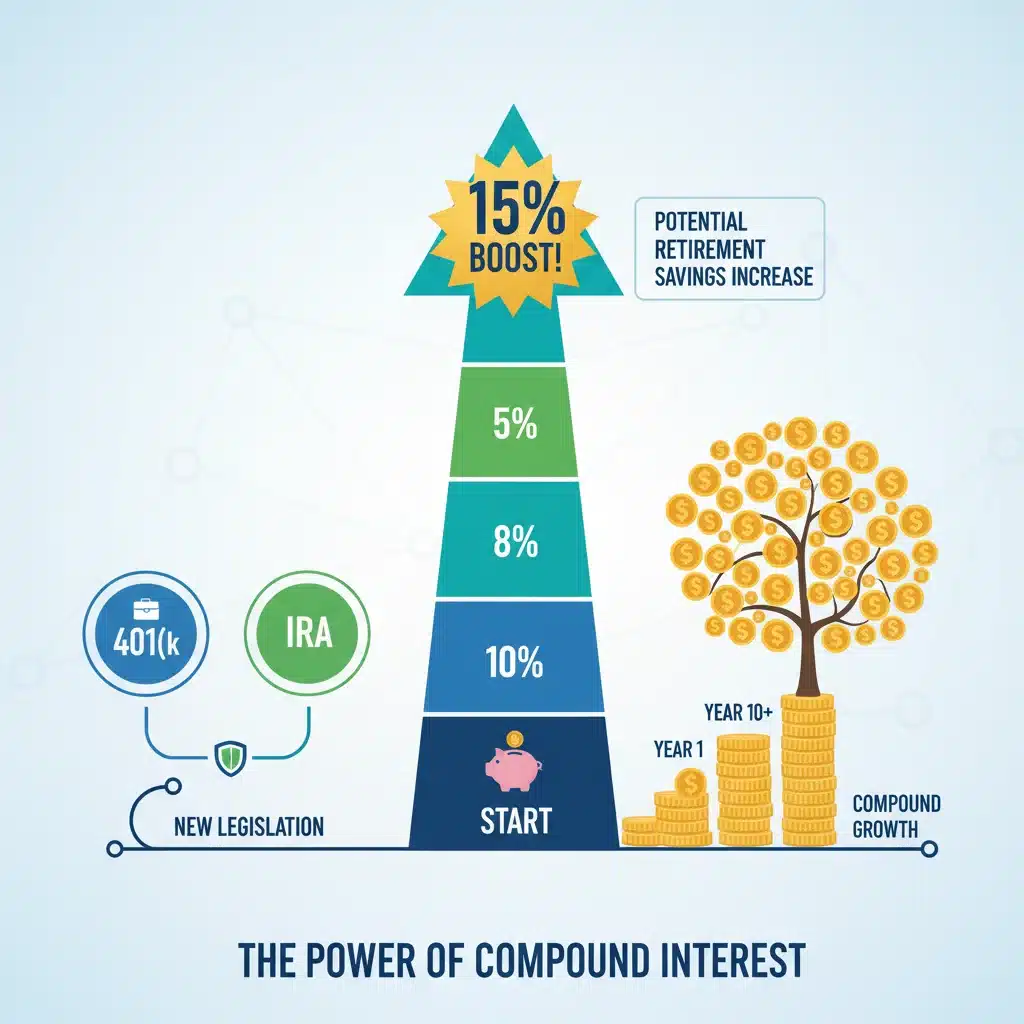
The 15% boost in retirement savings by 2026 is not a single magic bullet, but rather the cumulative effect of these various provisions working in concert. Let’s break down how this can happen:
- Increased Contribution Limits: Higher catch-up contribution limits for 401(k)s and IRAs directly translate to more money being saved annually. For someone maximizing these new limits, the additional contributions over a few years can add up significantly.
- Automatic Enrollment and Escalation: For individuals who might not have actively participated in their 401(k)s, automatic enrollment ensures they start saving. The automatic escalation feature ensures their contributions grow over time, harnessing the power of compounding from an earlier stage. This passive increase in savings can lead to substantial growth.
- Student Loan Matching: This provision effectively provides ‘free money’ in the form of employer contributions that employees might otherwise miss out on. By not having to choose between debt repayment and retirement savings, individuals can build their retirement fund without additional out-of-pocket expenses, leading to a net gain in savings.
- Roth Options: While not directly increasing the dollar amount saved, the Roth options in 401(k)s, SIMPLE IRAs, and SEP IRAs can significantly enhance the *net* value of your retirement savings by making withdrawals tax-free in retirement. This tax efficiency can be equivalent to a substantial boost in purchasing power.
- Improved Financial Literacy and Access: By simplifying rules and expanding access, the SECURE 2.0 Act encourages more people to save, and to save more effectively. This broader participation and more informed decision-making inherently lead to higher aggregate savings across the population.
Consider a scenario where an individual aged 60 takes advantage of the increased 401(k) catch-up contributions, benefits from employer student loan matching, and strategically uses Roth options. The combined effect of these additional contributions, employer matches, and tax-free growth can easily lead to a 15% or even greater increase in their projected retirement fund compared to what would have been possible under previous legislation. The power of compounding on these additional contributions over just a few years can be quite remarkable.
Strategic Planning for the SECURE 2.0 Act in 2026
To fully leverage the benefits of the SECURE 2.0 Act, proactive planning is essential. Here are some actionable strategies to consider:
Review Your Current Contribution Strategy
If you are nearing retirement age (60-63), re-evaluate your 401(k) and IRA contributions. With the increased catch-up limits, you might have the opportunity to significantly boost your savings in a relatively short period. Maximize these opportunities if your financial situation allows. Even if you are younger, understanding the automatic enrollment and escalation features means you should be aware of your plan’s default settings and adjust them to your comfort level, ideally opting for the maximum contribution you can afford.
Assess Your Tax Diversification
With the expansion of Roth options, now is an excellent time to consider a balanced approach to your retirement savings. Having a mix of pre-tax (traditional 401(k)/IRA) and after-tax (Roth 401(k)/IRA) accounts provides flexibility in managing your tax burden in retirement. Consult a financial advisor to determine if contributing to Roth accounts, especially for catch-up contributions if you are a high earner, aligns with your long-term tax strategy.
Engage with Your Employer About Student Loan Matching
If you have student loan debt, speak with your employer’s HR or benefits department to understand if they plan to implement the student loan payment matching provision. This could be a significant benefit, allowing you to save for retirement without diverting funds from debt repayment. Advocate for its implementation if it’s not yet offered.
Stay Informed About RMD Changes
While the primary RMD age was already pushed back by the original SECURE Act, the SECURE 2.0 Act further delays the RMD age to 73 (starting in 2023) and eventually to 75 (starting in 2033). This gives your savings more time to grow tax-deferred. Understand these timelines and adjust your withdrawal strategies accordingly to optimize tax efficiency and ensure your money lasts longer. This extended deferral period can compound the growth of your retirement assets.
Consult a Financial Advisor
The complexities of the SECURE 2.0 Act and its interplay with your unique financial situation warrant professional guidance. A qualified financial advisor can help you understand the specific implications of these changes for your retirement plan, identify opportunities to maximize your savings, and assist in developing a tailored strategy that aligns with your financial goals and risk tolerance. They can also help you navigate the fine print of the legislation, such as income thresholds for Roth catch-up contributions and the specifics of QCDs.
Challenges and Considerations
While the SECURE 2.0 Act presents numerous opportunities, it also introduces complexities. Employers will need to update their plan administration systems, and individuals will need to stay vigilant about understanding the new rules. Some potential challenges include:
- Employer Adoption: Not all employers may immediately adopt every provision, such as student loan matching, due to administrative costs or complexity. It’s crucial for employees to inquire about their employer’s plans.
- Increased Administrative Burden: For plan administrators, the new rules, especially regarding Roth catch-up contributions for high earners and student loan matching, add layers of complexity to compliance and record-keeping.
- Individual Responsibility: While the act aims to simplify saving, individuals still bear the responsibility of staying informed and making active choices to maximize their benefits. Automatic enrollment is a start, but optimizing contributions and investment choices still requires engagement.
- Inflation Adjustments: Many of the new limits are indexed to inflation, which means they will change over time. Staying updated on these annual adjustments is necessary for accurate planning.
Despite these considerations, the overarching sentiment is that the SECURE 2.0 Act is a net positive for retirement savers. The benefits of increased flexibility, expanded access, and enhanced savings opportunities far outweigh the challenges, provided individuals and employers are prepared to adapt.
Conclusion: A Brighter Retirement Horizon with the SECURE 2.0 Act
The SECURE 2.0 Act represents a monumental step forward in strengthening America’s retirement system. As its provisions fully come into effect in 2026, individuals will find themselves with more tools, greater flexibility, and enhanced opportunities to build a robust retirement fund. From significantly increased catch-up contributions for older workers to innovative features like student loan payment matching and expanded Roth options, the act is designed to tackle various barriers to effective retirement saving.
The potential to boost your retirement savings by up to 15% is not an exaggeration; it’s a realistic outcome for those who strategically engage with these new rules. By understanding the core changes, reviewing your current financial plan, and consulting with financial professionals, you can position yourself to take full advantage of the SECURE 2.0 Act. Your proactive engagement today will lay the foundation for a more secure, comfortable, and financially independent retirement tomorrow. Don’t let these opportunities pass you by; start planning now to ensure your retirement benefits are maximized under this transformative legislation.