Student Loan Management: Reduce Payments Up to 15% in 2026

Anúncios
Practical Solutions for Student Loan Management: Reducing Your Payments by Up to 15% in 2026
Student loan debt is a significant burden for millions, impacting financial freedom and long-term planning. The good news is that with effective student loan management, you can significantly alleviate this pressure. This comprehensive guide will equip you with practical strategies and insights to potentially reduce your student loan payments by up to 15% in 2026. We’ll delve into various repayment options, refinancing strategies, and smart financial habits that can make a substantial difference in your financial well-being.
Anúncios
As we approach 2026, understanding the landscape of student loan policies and market trends becomes crucial. Proactive student loan management isn’t just about making minimum payments; it’s about optimizing your repayment strategy to save money, reduce interest, and accelerate your path to debt freedom. Whether you’re just starting repayment, struggling to keep up, or looking to fine-tune an existing plan, the information presented here will provide actionable steps.
Understanding Your Current Student Loan Landscape
Before you can effectively reduce your student loan payments, you need a clear picture of your current situation. This involves understanding the types of loans you have (federal or private), their interest rates, your current repayment plan, and your total outstanding balance. This foundational knowledge is the first step in strategic student loan management.
Federal vs. Private Student Loans
- Federal Student Loans: These loans are issued by the U.S. Department of Education. They often come with more flexible repayment options, such as income-driven repayment plans, deferment, and forbearance. Their interest rates are fixed.
- Private Student Loans: These are offered by banks, credit unions, and other private lenders. They typically have fewer borrower protections and repayment flexibilities than federal loans. Interest rates can be fixed or variable, and often depend on your creditworthiness.
The distinction between federal and private loans is critical because it dictates the types of relief and repayment strategies available to you. Federal loans offer a broader range of options for student loan management that can lead to lower monthly payments.
Knowing Your Interest Rates and Balances
Gather all your loan statements and create a spreadsheet or use a financial tracking tool to list each loan individually. Include:
- Lender name
- Original loan amount
- Current balance
- Interest rate (fixed or variable)
- Minimum monthly payment
- Remaining term
This detailed overview will help you identify which loans are costing you the most and where you might find the greatest opportunities for savings through improved student loan management.
Strategic Repayment Plans for Federal Student Loans
Federal student loans offer several repayment plans designed to help borrowers manage their debt. Exploring these options is often the most direct path to reducing your monthly payments. As part of effective student loan management, understanding these plans is paramount.
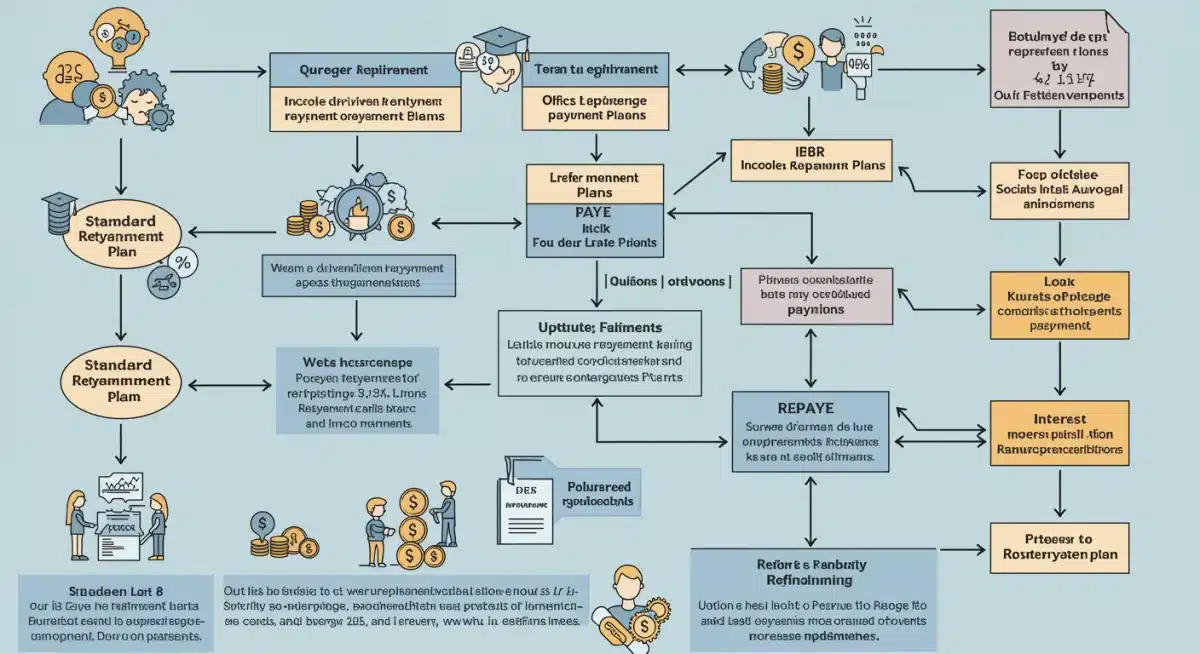
Income-Driven Repayment (IDR) Plans
IDR plans calculate your monthly payment based on your income and family size, rather than your loan balance. This can lead to significantly lower payments, sometimes as low as $0 per month. There are several types of IDR plans:
- Revised Pay As You Earn (REPAYE): Generally caps payments at 10% of your discretionary income.
- Pay As You Earn (PAYE): Caps payments at 10% of your discretionary income, but never more than the 10-year Standard Repayment Plan amount.
- Income-Based Repayment (IBR): Caps payments at 10% or 15% of your discretionary income, depending on when you took out your loans.
- Income-Contingent Repayment (ICR): Caps payments at 20% of your discretionary income or what you would pay on a fixed 12-year repayment plan, whichever is less.
- Saving on a Valuable Education (SAVE) Plan: This is a newer IDR plan that replaces REPAYE. It offers significant benefits, including a lower discretionary income percentage for undergraduate loans (5% starting July 2024), and no interest accrual if your payment doesn’t cover the interest. This plan is a major game-changer for student loan management.
IDR plans also offer loan forgiveness after 20 or 25 years of qualifying payments (depending on the plan and loan type). While this is a long-term benefit, the immediate reduction in monthly payments can be life-changing. Regularly recertifying your income and family size is a crucial aspect of maintaining these lower payments.
Extended and Graduated Repayment Plans
- Extended Repayment Plan: If you have more than $30,000 in federal loans, you can extend your repayment period for up to 25 years, resulting in lower monthly payments than the standard 10-year plan.
- Graduated Repayment Plan: Payments start low and gradually increase every two years. This can be helpful if you expect your income to rise over time, making it a viable short-term student loan management strategy.
It’s important to note that while these plans lower your monthly payments, you’ll likely pay more interest over the life of the loan due to the extended repayment period. However, for immediate financial relief, they can be excellent options.
Refinancing Private and Federal Student Loans
Refinancing is a powerful tool in student loan management, especially for those with high-interest private loans or federal loans where borrower protections are less of a concern. Refinancing involves taking out a new loan to pay off your existing student loans, ideally with a lower interest rate or a more favorable repayment term.
When to Consider Refinancing
Refinancing is typically beneficial if:
- You have a strong credit score (typically 670 or higher) and a stable income.
- Interest rates have dropped since you took out your original loans.
- You want to consolidate multiple loans into a single payment.
- You want to change your loan term (e.g., shorten it to pay less interest, or lengthen it to reduce monthly payments).
- You have private loans with high variable interest rates and want a fixed rate.
Crucial Consideration for Federal Loans: Refinancing federal loans into a private loan means you lose all federal borrower protections, including access to IDR plans, deferment, forbearance, and potential loan forgiveness programs. This is a significant trade-off that requires careful consideration as part of your student loan management strategy.
How Refinancing Can Reduce Payments by Up to 15%
A lower interest rate directly translates to lower monthly payments and less interest paid over the life of the loan. Even a reduction of 1-2 percentage points can lead to substantial savings. For example, if you have $50,000 in loans at 6.5% interest over 10 years, your payment is about $568. Refinancing to 4.5% could reduce your payment to approximately $519, a saving of nearly 9%. If you also extend the loan term (e.g., from 10 to 15 years), the payment reduction can be even more dramatic, easily reaching or exceeding 15%.
It’s vital to shop around and compare offers from multiple lenders to find the best rates and terms. Many online lenders specialize in student loan refinancing and offer pre-qualification options that don’t impact your credit score.
Navigating Deferment and Forbearance
For times of financial hardship, deferment and forbearance can provide temporary relief from student loan payments. While these options don’t reduce your overall debt, they can prevent default and offer a breathing room to get your finances in order. They are important components of a flexible student loan management plan.
Deferment
Deferment allows you to temporarily postpone payments. For certain federal loans (subsidized federal loans, Perkins Loans, and the subsidized portion of Direct Consolidation Loans), interest does not accrue during deferment. Common reasons for deferment include:
- In-school deferment
- Graduate fellowship deferment
- Unemployment deferment
- Economic hardship deferment
Forbearance
Forbearance also allows you to temporarily stop or reduce your payments. However, interest typically accrues on all loan types (subsidized and unsubsidized) during forbearance. It’s usually granted for up to 12 months at a time and can be renewed. Reasons for forbearance often include:
- Financial difficulties
- Illness
- Other personal circumstances
While deferment and forbearance can be lifesavers, they should be used judiciously as part of your student loan management strategy. Interest accrual, especially during forbearance, means your total debt will grow, making it harder to pay off in the long run.
Smart Budgeting and Financial Habits to Complement Student Loan Management
Beyond specific loan programs, adopting sound financial habits is crucial for effective student loan management. A well-structured budget and disciplined spending can free up funds to either make extra payments or reduce reliance on temporary payment relief.
Creating a Detailed Budget
A budget helps you understand where your money is going. Track all your income and expenses for at least a month. Categorize your spending to identify areas where you can cut back. Popular budgeting methods include:
- 50/30/20 Rule: 50% for needs, 30% for wants, 20% for savings and debt repayment.
- Zero-Based Budgeting: Every dollar has a job, leaving you with zero at the end of the month.
By optimizing your budget, you might find an extra 5-10% of your income that can be redirected towards your student loans, either for extra payments or to ensure you can comfortably afford a higher payment plan if that accelerates your debt freedom.
Building an Emergency Fund
An emergency fund is a critical buffer against unexpected expenses that could derail your student loan management efforts. Aim to save 3-6 months’ worth of living expenses in a separate, easily accessible savings account. This fund prevents you from relying on high-interest credit cards or delaying student loan payments when unforeseen costs arise.
Exploring Side Gigs or Additional Income Streams
If your current income makes it challenging to meet your financial goals and manage student loans, consider exploring side hustles or additional income streams. Even a few hundred extra dollars a month can significantly impact your ability to make larger payments or build savings, accelerating your debt repayment.

Leveraging Loan Forgiveness Programs
While not applicable to everyone, certain federal loan forgiveness programs can eliminate a portion or all of your federal student loan debt. These programs are a powerful aspect of student loan management for eligible individuals.
Public Service Loan Forgiveness (PSLF)
PSLF forgives the remaining balance on your Direct Loans after you’ve made 120 qualifying monthly payments while working full-time for a qualifying employer. Qualifying employers include:
- Government organizations (federal, state, local, or tribal)
- Not-for-profit organizations that are tax-exempt under Section 501(c)(3) of the Internal Revenue Code
- Other not-for-profit organizations that provide certain public services
If you qualify, PSLF can provide immense relief. It’s crucial to ensure you meet all the strict requirements and submit the necessary employment certification forms regularly.
Teacher Loan Forgiveness
Teachers who work full-time for five consecutive years in certain low-income schools or educational service agencies may be eligible for forgiveness of up to $17,500 on their Direct Subsidized and Unsubsidized Loans and their Subsidized and Unsubsidized Federal Stafford Loans.
Other Forgiveness and Discharge Options
Other less common scenarios for loan forgiveness or discharge include:
- Total and Permanent Disability (TPD) Discharge: For borrowers who are permanently disabled.
- Borrower Defense to Repayment: For borrowers who were defrauded by their school.
- Closed School Discharge: For borrowers whose school closed while they were enrolled or shortly after withdrawing.
Regularly check the Federal Student Aid website for updates on these programs, as policies can change, impacting your student loan management strategy.
Consolidation for Federal Student Loans
Federal student loan consolidation allows you to combine multiple federal education loans into a single Direct Consolidation Loan. This can simplify your payments, as you’ll only have one loan servicer and one monthly bill. While consolidation doesn’t necessarily lower your interest rate (it’s a weighted average of your existing rates, rounded up to the nearest one-eighth of a percentage point), it can offer other benefits for student loan management:
- Access to IDR Plans: Some older federal loans (like FFEL Program loans) may not be eligible for all IDR plans unless they are first consolidated into a Direct Consolidation Loan.
- Extended Repayment Terms: You can extend your repayment period up to 30 years, which will reduce your monthly payment, though you’ll pay more interest over time.
- New Fixed Interest Rate: If you have variable-rate FFEL loans, consolidation can convert them to a fixed interest rate.
It’s important not to confuse federal loan consolidation with private loan refinancing. Federal consolidation keeps your loans federal, preserving access to federal benefits. Refinancing, as discussed, moves federal loans to a private lender, forfeiting those benefits.
Proactive Steps for 2026 and Beyond
As 2026 approaches, staying informed about potential policy changes and economic shifts is key to effective student loan management. The student loan landscape is dynamic, and new opportunities or challenges may emerge.
Stay Informed and Review Annually
Make it a habit to review your student loan situation at least once a year. Check for changes in interest rates (if applicable), evaluate your income and family size for IDR plans, and look for new programs or legislative updates. The Federal Student Aid website (studentaid.gov) is your primary resource for federal loan information.
Consider Professional Financial Advice
If your student loan situation is complex, or you’re unsure which path to take, consider consulting a non-profit credit counselor or a financial advisor specializing in student loan debt. They can offer personalized advice and help you navigate the various options for optimal student loan management.
Automate Payments and Pay Extra When Possible
Even a small extra payment each month can significantly reduce the total interest paid and shorten your repayment term. Setting up automated payments not only ensures you don’t miss a payment but also often qualifies you for a small interest rate reduction (e.g., 0.25%) from your loan servicer.
Conclusion: Empowering Your Student Loan Management Journey
Reducing your student loan payments by up to 15% in 2026 is an ambitious yet achievable goal with the right strategies and consistent effort. By understanding your loan types, exploring federal repayment plans like the SAVE plan, strategically considering refinancing for private loans, and adopting robust financial habits, you can take control of your financial future.
Effective student loan management is a continuous process. It requires diligence, informed decision-making, and a willingness to adapt as your financial situation or loan policies change. Start by gathering all your loan information, assessing your budget, and then systematically exploring the options available to you. With these practical solutions, you’ll be well on your way to alleviating the burden of student debt and achieving greater financial stability.