Student Loan Forgiveness 2026: Updates, Eligibility & Programs
Anúncios
Student Loan Forgiveness Programs 2026: Understanding the Latest Updates and Eligibility for U.S. Borrowers
For millions of Americans, the burden of student loan debt is a significant financial challenge that can impact life choices, career paths, and overall economic well-being. As we look towards 2026, the landscape of student loan forgiveness continues to evolve, with new policies, program adjustments, and ongoing debates shaping the future of student debt relief. Understanding these changes is crucial for borrowers seeking to alleviate their financial strain.
The concept of student loan forgiveness has gained considerable traction in recent years, moving from a niche topic to a central point of policy discussion. The sheer volume of outstanding student debt in the United States—totaling trillions of dollars—underscores the urgency and importance of effective relief mechanisms. For many, the promise of forgiveness offers a glimmer of hope, a potential pathway to financial freedom that once seemed unattainable. However, navigating the complexities of various programs, eligibility criteria, and application processes can be daunting.
Anúncios
This comprehensive guide aims to demystify Student Loan Forgiveness 2026, providing U.S. borrowers with a clear, up-to-date overview of what to expect. We will delve into the current state of federal and state-level programs, examine potential legislative changes, and offer practical advice on how to assess your eligibility and pursue the relief you deserve. Whether you are a recent graduate, a long-time borrower, or someone considering higher education, staying informed about these developments is paramount.
The journey to understanding student loan forgiveness is often filled with questions: What programs are available? Am I eligible? How do I apply? What are the potential pitfalls? This article will address these questions and more, ensuring you have the knowledge to make informed decisions about your student loan debt. The goal is not just to inform but to empower borrowers to take proactive steps towards managing and potentially eliminating their student loan obligations.
The Evolving Landscape of Student Loan Forgiveness
The past few years have seen unprecedented changes in student loan policy, largely influenced by economic conditions and political priorities. While some temporary relief measures, such as the pandemic-era payment pause, have concluded, the conversation around permanent solutions for Student Loan Forgiveness 2026 remains robust. It’s important to distinguish between broad, one-time forgiveness initiatives and ongoing, established programs.
Federal student loan programs are the primary focus of most forgiveness discussions. These programs are typically managed by the Department of Education and offer various pathways to debt relief based on factors such as employment type, income, and specific circumstances. State-level programs also play a role, often targeting specific professions or residents within their borders.
As we approach 2026, several key areas are expected to see continued evolution. These include potential adjustments to existing income-driven repayment (IDR) plans, expansions or modifications of public service loan forgiveness (PSLF), and ongoing discussions about broader debt cancellation. The political climate will undoubtedly influence the pace and scope of these changes, making it essential for borrowers to stay abreast of legislative developments and official announcements from the Department of Education.
One of the most significant challenges for borrowers is the sheer volume of information and, at times, misinformation surrounding student loan forgiveness. Official sources, such as the Federal Student Aid website, are the most reliable places for accurate and up-to-date information. This article aims to distill that information into an easily digestible format, helping you cut through the noise and focus on what truly matters for your financial future.
Key Federal Student Loan Forgiveness Programs for 2026
The bedrock of student loan forgiveness in the U.S. consists of several federal programs designed to help specific groups of borrowers. These programs have distinct eligibility requirements and application processes. Understanding each one is the first step in determining your potential for relief under Student Loan Forgiveness 2026.
Public Service Loan Forgiveness (PSLF)
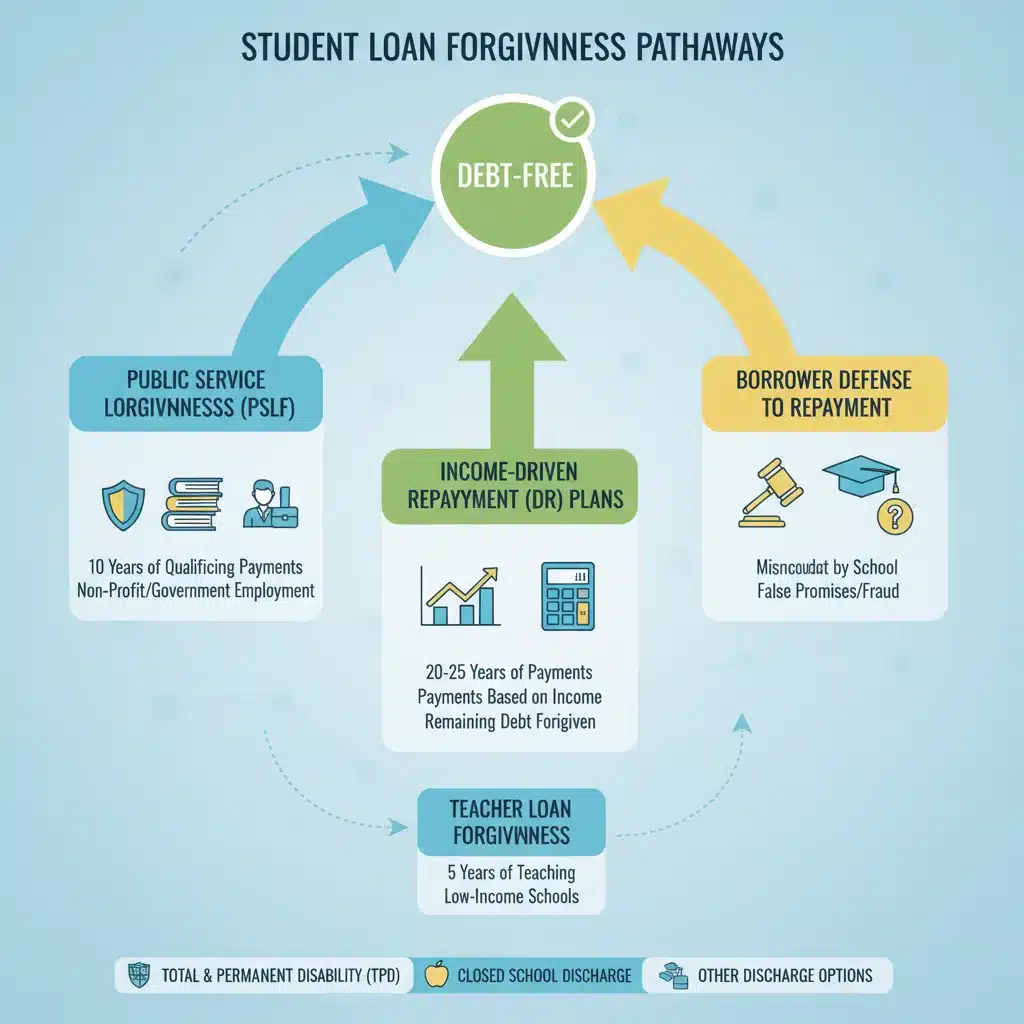
PSLF is arguably one of the most well-known and impactful federal forgiveness programs. It is designed for borrowers who work in public service jobs and make 120 qualifying monthly payments while employed full-time by a qualifying employer. Qualifying employers typically include government organizations (federal, state, local, or tribal) and not-for-profit organizations that are tax-exempt under Section 501(c)(3) of the Internal Revenue Code. Other non-profits that provide certain public services may also qualify.
Eligibility Criteria for PSLF:
- Employment: Must be employed full-time by a qualifying public service employer.
- Loan Type: Only Direct Loans qualify. If you have FFEL Program loans or Perkins Loans, you must consolidate them into a Direct Consolidation Loan to be eligible.
- Payment Plan: You must be on an income-driven repayment (IDR) plan.
- Payments: Make 120 qualifying monthly payments (10 years’ worth) while meeting the employment and loan type criteria.
The PSLF program has undergone significant reforms in recent years, including temporary waivers that made it easier for past payments to count towards the 120-payment requirement. While these waivers may not be active in 2026, their impact on the program’s administration and potential future adjustments is noteworthy. Borrowers should regularly submit the PSLF Employment Certification Form to track their progress and ensure their employment qualifies.
Income-Driven Repayment (IDR) Plan Forgiveness
Income-driven repayment (IDR) plans are designed to make student loan payments more affordable by capping them at a percentage of your discretionary income. A significant benefit of IDR plans is that any remaining loan balance is forgiven after 20 or 25 years of payments, depending on the specific plan and whether you have loans for undergraduate or graduate study.
There are several IDR plans, including:
- Revised Pay As You Earn (REPAYE)
- Pay As You Earn (PAYE)
- Income-Based Repayment (IBR)
- Income-Contingent Repayment (ICR)
The Biden administration has also introduced the SAVE Plan (Saving on a Valuable Education), which replaced the REPAYE plan and offers even more generous terms for many borrowers, including lower monthly payments and a faster path to forgiveness for some. The SAVE Plan is expected to be a cornerstone of Student Loan Forgiveness 2026 efforts.
Key features of the SAVE Plan include:
- Lower monthly payments for many borrowers.
- Interest subsidy: If your calculated payment doesn’t cover the monthly interest, the government covers the remaining interest, preventing your balance from growing.
- Shorter forgiveness timelines for some borrowers (as low as 10 years for original balances of $12,000 or less).
It’s crucial to recertify your income and family size annually for IDR plans to ensure your payments remain accurate and you continue to qualify for forgiveness.
Borrower Defense to Repayment
This program offers loan forgiveness to students who were misled by their college or whose college engaged in misconduct in violation of certain state laws. This could include false promises about job placement rates, program accreditation, or the quality of education. Claims are evaluated on a case-by-case basis.
Eligibility for Borrower Defense:
- You must demonstrate that your school engaged in misconduct that directly relates to your federal student loans or the education services for which the loans were provided.
- This typically applies to federal Direct Loans.
The process for borrower defense claims has seen significant changes and backlogs in recent years, but the Department of Education continues to process applications and issue decisions. If you believe your school defrauded you, this program could be a viable path to Student Loan Forgiveness 2026.
Total and Permanent Disability (TPD) Discharge
Borrowers who are totally and permanently disabled may be eligible to have their federal student loans discharged. This can be demonstrated through documentation from the Department of Veterans Affairs (VA), the Social Security Administration (SSA), or a physician.
Eligibility for TPD Discharge:
- You must be unable to engage in any substantial gainful activity due to a physical or mental impairment that is expected to result in death, has lasted for a continuous period of at least 60 months, or is expected to last for a continuous period of at least 60 months.
There is a three-year monitoring period after discharge to ensure borrowers do not exceed certain income thresholds or re-enroll in school.
Closed School Discharge
If your school closes while you are enrolled or soon after you withdraw, you may be eligible for a 100% discharge of your federal student loans. This applies if you were unable to complete your program of study because your school closed.
Eligibility for Closed School Discharge:
- Your school closed while you were enrolled, or within 180 days after you withdrew.
- You did not complete your program of study.
- You did not transfer your credits to another school or complete a comparable program at another school.
This discharge is often automatic for eligible borrowers, but it’s wise to confirm your eligibility and status with your loan servicer.
State-Specific and Professional Forgiveness Programs
Beyond federal initiatives, many states and professional organizations offer their own student loan forgiveness or repayment assistance programs. These are often designed to address specific workforce shortages or encourage professionals to work in underserved areas. While the details vary significantly by location and profession, exploring these options can be a crucial part of your Student Loan Forgiveness 2026 strategy.
Healthcare Professionals
Many states, and even some federal agencies (like the National Health Service Corps), offer loan repayment programs for doctors, nurses, dentists, and other healthcare providers who agree to work in critical shortage areas for a specified period. These programs can be highly generous, often paying off a substantial portion of a borrower’s debt in exchange for service.
Teachers and Educators
Similar to healthcare, there are numerous programs for teachers, especially those who work in low-income schools or teach high-need subjects (like math, science, or special education). The federal Teacher Loan Forgiveness program offers up to $17,500 in forgiveness for eligible teachers, and many states have supplemental programs.
Lawyers and Public Defenders
Attorneys working in public service, such as public defenders, prosecutors, or those employed by non-profit organizations providing legal aid, may find state-specific loan repayment assistance programs (LRAPs) designed to mitigate the financial burden of their education while serving the public good. These often complement the federal PSLF program.
Other State-Specific Programs
It’s worth researching your state’s higher education agency or department to identify any unique programs. Some states offer general loan repayment assistance for residents, while others target specific industries or geographic regions. These programs can be competitive, so understanding application deadlines and requirements is essential.
To find state-specific programs, consider:
- Visiting your state’s Department of Education or higher education website.
- Consulting with your university’s financial aid office or career services.
- Using online databases that compile state and professional loan repayment programs.
Navigating Eligibility and Application for Student Loan Forgiveness 2026
Determining your eligibility and successfully applying for student loan forgiveness can be a complex process. It requires careful attention to detail, accurate record-keeping, and often, persistence. Here’s a step-by-step guide to help you navigate the process for Student Loan Forgiveness 2026.
Step 1: Understand Your Loan Types
The type of loan you have is the most critical factor in determining your eligibility for federal forgiveness programs. Only federal student loans, primarily Direct Loans, qualify for most forgiveness initiatives. If you have FFEL Program loans or Perkins Loans, you may need to consolidate them into a Direct Consolidation Loan to become eligible. Private student loans are generally not eligible for federal forgiveness programs.
You can find your federal student loan information by logging into your Federal Student Aid account.
Step 2: Research Program Requirements Thoroughly
Once you know your loan types, delve into the specific requirements for each program you might qualify for. Pay close attention to:
- Employment Criteria: For PSLF, this means knowing what constitutes a qualifying employer and full-time employment.
- Payment History: For PSLF and IDR forgiveness, track your qualifying payments diligently.
- Income and Family Size: For IDR plans, these factors directly impact your monthly payment and, consequently, your path to forgiveness.
- Specific Conditions: For programs like Borrower Defense or TPD Discharge, understand the evidence required to support your claim.
Step 3: Gather Necessary Documentation
A successful application hinges on thorough documentation. This may include:
- Proof of employment (for PSLF, regular submission of the PSLF Employment Certification Form is vital).
- Income verification (tax returns, pay stubs for IDR plans).
- Medical documentation (for TPD discharge).
- School transcripts and enrollment records (for Closed School Discharge or Borrower Defense).
Keep copies of all submitted documents and correspondence with your loan servicer and the Department of Education.
Step 4: Contact Your Loan Servicer
Your loan servicer is your primary point of contact for managing your federal student loans. They can provide specific forms, answer questions about your eligibility, and guide you through the application process. Be prepared with your account information and specific questions when you call.
Step 5: Apply and Follow Up
Submit your applications carefully and completely. After submission, keep track of your application status. Don’t hesitate to follow up with your loan servicer if you don’t hear back within their stated timeframe. Persistence can be key, especially for complex cases.
Step 6: Beware of Scams
Unfortunately, the student loan landscape is also home to scams. Be wary of companies that promise guaranteed forgiveness for a fee, ask for your FSA ID, or pressure you to act quickly. Legitimate forgiveness programs do not require upfront payments, and you can generally apply for them directly through your loan servicer or the Federal Student Aid website for free.

Potential Legislative Changes and Future Outlook for 2026
The political and economic climate significantly influences the future of student loan forgiveness. As we look toward Student Loan Forgiveness 2026, it’s essential to consider potential legislative changes and policy shifts that could impact existing programs or introduce new forms of relief.
Ongoing Debates and Proposals
Discussions around broader student debt cancellation continue at the federal level. While large-scale, across-the-board forgiveness has faced legal and political hurdles, targeted forgiveness through existing programs (like PSLF and IDR) and new administrative actions remains a focus. Policymakers are continually evaluating the effectiveness of current programs and exploring ways to make higher education more affordable and manageable.
Potential areas for future legislative action or administrative changes might include:
- Simplification of IDR Plans: Further streamlining and simplifying the various IDR plans to reduce confusion and increase accessibility.
- Expansion of PSLF Eligibility: Broadening the definition of "qualifying employer" or "full-time employment" to include more public service roles.
- Addressing Loan Interest: New mechanisms to cap or reduce interest accumulation on federal student loans, making repayment more manageable.
- Targeted Forgiveness Initiatives: Specific relief for borrowers in extreme hardship, those who attended predatory institutions, or individuals with very old debts.
Economic Factors
The broader economic environment — including inflation, interest rates, and the job market — can also influence student loan policy. Periods of economic downturn often lead to increased calls for debt relief, while robust economic growth might shift the focus elsewhere. The impact of student debt on consumer spending and the overall economy is a constant consideration for policymakers.
The Role of Advocacy Groups
Student advocacy groups and non-profit organizations play a vital role in pushing for student loan reform. Their efforts in research, lobbying, and public awareness help keep student debt a priority issue for lawmakers. Staying connected with these groups can provide insights into potential future developments and opportunities for action.
While predicting the exact future of Student Loan Forgiveness 2026 is challenging, it’s clear that the conversation and efforts to provide relief will continue. Borrowers should remain informed, proactive, and engaged with official sources to best position themselves for any available opportunities.
Strategies for Managing Student Loan Debt Beyond Forgiveness
While student loan forgiveness is a powerful tool, it’s not the only strategy for managing student debt. A comprehensive approach often involves a combination of repayment strategies, financial planning, and proactive engagement with your loan servicer. Even if you qualify for Student Loan Forgiveness 2026, understanding these additional strategies can enhance your financial stability.
1. Understand Your Repayment Options
Before pursuing forgiveness, ensure you are on the most suitable repayment plan. Federal student loans offer several options:
- Standard Repayment Plan: Fixed payments over 10 years.
- Graduated Repayment Plan: Payments start low and increase every two years.
- Extended Repayment Plan: Lower payments over a longer period (up to 25 years) for borrowers with higher loan balances.
- Income-Driven Repayment (IDR) Plans: Payments based on income and family size, leading to forgiveness after 20 or 25 years (or less with the SAVE plan).
Choosing the right plan can significantly impact your monthly budget and long-term financial health.
2. Consider Loan Consolidation
Federal loan consolidation combines multiple federal loans into a single Direct Consolidation Loan. This can simplify your payments, potentially lower your monthly amount (by extending the repayment period), and make you eligible for certain IDR plans or PSLF if your original loans were not Direct Loans. However, it can also increase the total interest paid over the life of the loan.
3. Explore Refinancing Private Loans
If you have private student loans, or if you have federal loans and don’t qualify for forgiveness and can secure a lower interest rate, refinancing might be an option. Refinancing involves taking out a new loan from a private lender to pay off your existing loans. This can lower your interest rate, reduce your monthly payment, or shorten your repayment term. However, refinancing federal loans into private loans means losing access to federal benefits like IDR plans, deferment, forbearance, and forgiveness programs.
4. Make Extra Payments When Possible
If your budget allows, making extra payments can significantly reduce the total interest you pay and shorten your repayment period. Direct these extra payments specifically to the principal balance of your highest-interest loans first.
5. Build an Emergency Fund
Having an emergency fund (3-6 months of living expenses) can prevent you from falling behind on student loan payments if unexpected financial challenges arise. This reduces the need for forbearance or deferment, which can extend your loan term and increase total interest.
6. Seek Financial Counseling
Non-profit credit counseling agencies or financial advisors specializing in student debt can provide personalized advice. They can help you analyze your financial situation, understand your options, and develop a tailored repayment strategy that aligns with your goals for Student Loan Forgiveness 2026 and beyond.
7. Stay Informed and Proactive
The student loan landscape is dynamic. Regularly check official sources like StudentAid.gov, subscribe to updates from the Department of Education, and read reputable financial news to stay informed about any new programs, policy changes, or deadlines that could affect your loans.
Conclusion: Preparing for Student Loan Forgiveness 2026
The journey to managing and potentially eliminating student loan debt is a marathon, not a sprint. As we look ahead to Student Loan Forgiveness 2026, the message for U.S. borrowers is clear: stay informed, understand your options, and take proactive steps.
The availability of federal programs like PSLF, IDR forgiveness (especially with the new SAVE Plan), Borrower Defense, TPD Discharge, and Closed School Discharge offers significant pathways to relief for eligible individuals. Coupled with state-specific and professional programs, there are multiple avenues to explore. However, each program comes with its own intricate set of rules, requiring careful attention to eligibility criteria, documentation, and consistent follow-up.
The political and economic environment will continue to shape the future of student loan policy. While broad, sweeping forgiveness may remain elusive, targeted administrative actions and potential legislative adjustments to existing programs are likely. This underscores the importance of regularly checking official government sources for the most accurate and up-to-date information.
Ultimately, empowering yourself with knowledge is the best defense against the complexities of student loan debt. By understanding your loan types, researching available programs, maintaining meticulous records, and engaging with your loan servicer, you can significantly improve your chances of qualifying for Student Loan Forgiveness 2026 or effectively managing your debt through other strategic repayment options.
Don’t let the weight of student loans define your financial future. Take control, explore every available option, and work towards the financial freedom you deserve. The resources and programs are there; it’s up to you to utilize them effectively.