Navigating Treasury Yields: Fixed-Income Strategies for 2026
Anúncios
Navigating Treasury Yields: Fixed-Income Strategies for 2026
The financial landscape is in a constant state of flux, and few indicators are as pivotal to fixed-income investors as Treasury yields. As we look towards 2026, understanding the trajectory and implications of these yields is not just beneficial, but essential for safeguarding and growing fixed-income portfolios. The decisions made today, informed by a keen understanding of the macro-economic environment and the intricacies of the bond market, will profoundly shape investment outcomes in the coming years. This comprehensive guide delves into the current state of Treasury yields, their expected evolution, and actionable strategies for fixed-income investors to thrive in this dynamic environment.
Anúncios
For many years, investors grew accustomed to a low-yield environment, which pushed them into riskier assets in search of returns. However, recent economic shifts, including persistent inflation, central bank policy adjustments, and geopolitical events, have ushered in a new era for bond markets. The rise in Treasury Yields 2026 has been a significant development, presenting both challenges and opportunities that demand a re-evaluation of traditional fixed-income approaches. This article aims to equip you with the knowledge and tools to navigate these complexities, ensuring your fixed-income portfolio is robust and resilient.
Understanding the Current Landscape of Treasury Yields
Before we can strategize for 2026, it’s crucial to grasp the factors currently influencing Treasury yields. Several key elements are at play, creating a complex web of interconnected forces that dictate the direction and volatility of the bond market.
Inflationary Pressures and Monetary Policy
One of the primary drivers of recent yield movements has been inflation. High inflation erodes the purchasing power of future fixed payments from bonds, making them less attractive unless their yields compensate for this loss. Central banks, in their efforts to combat inflation, have aggressively raised interest rates. This tightening monetary policy directly impacts short-term Treasury yields and, by extension, influences longer-term yields as well. The market’s expectation of future interest rate hikes and cuts, often referred to as the ‘forward guidance’ from central banks, plays a significant role in shaping the yield curve.
Economic Growth and Outlook
The health of the economy is another critical determinant. A strong economy typically leads to higher corporate earnings, which can divert investment from safe-haven Treasuries to equities. Conversely, a weakening economy or recessionary fears often drive investors towards the safety of government bonds, pushing yields down. However, in an inflationary environment, even a strong economy might see central banks continuing to hike rates, leading to higher yields. The interplay between economic growth, inflation, and monetary policy creates a delicate balance that investors must constantly monitor.
Geopolitical Events and Global Demand
Global events, from international conflicts to trade disputes, can significantly impact Treasury yields. During times of uncertainty, investors often flock to U.S. Treasuries, considered among the safest assets globally, which can push their prices up and yields down. Conversely, large government deficits requiring substantial bond issuance can increase supply, potentially pushing yields higher if demand doesn’t keep pace. The global demand for U.S. debt from foreign central banks and institutional investors also plays a crucial role in determining yield levels.
Supply and Demand Dynamics
The sheer volume of U.S. Treasury issuance to finance government spending is a fundamental factor. When the government issues more debt, it increases the supply of Treasuries in the market. If this increased supply is not met with sufficient demand from investors, yields tend to rise to attract buyers. Conversely, strong demand for a limited supply of Treasuries can drive yields lower. Understanding the government’s borrowing needs and the market’s capacity to absorb new debt is essential for forecasting yield movements.
Anticipating Treasury Yields in 2026
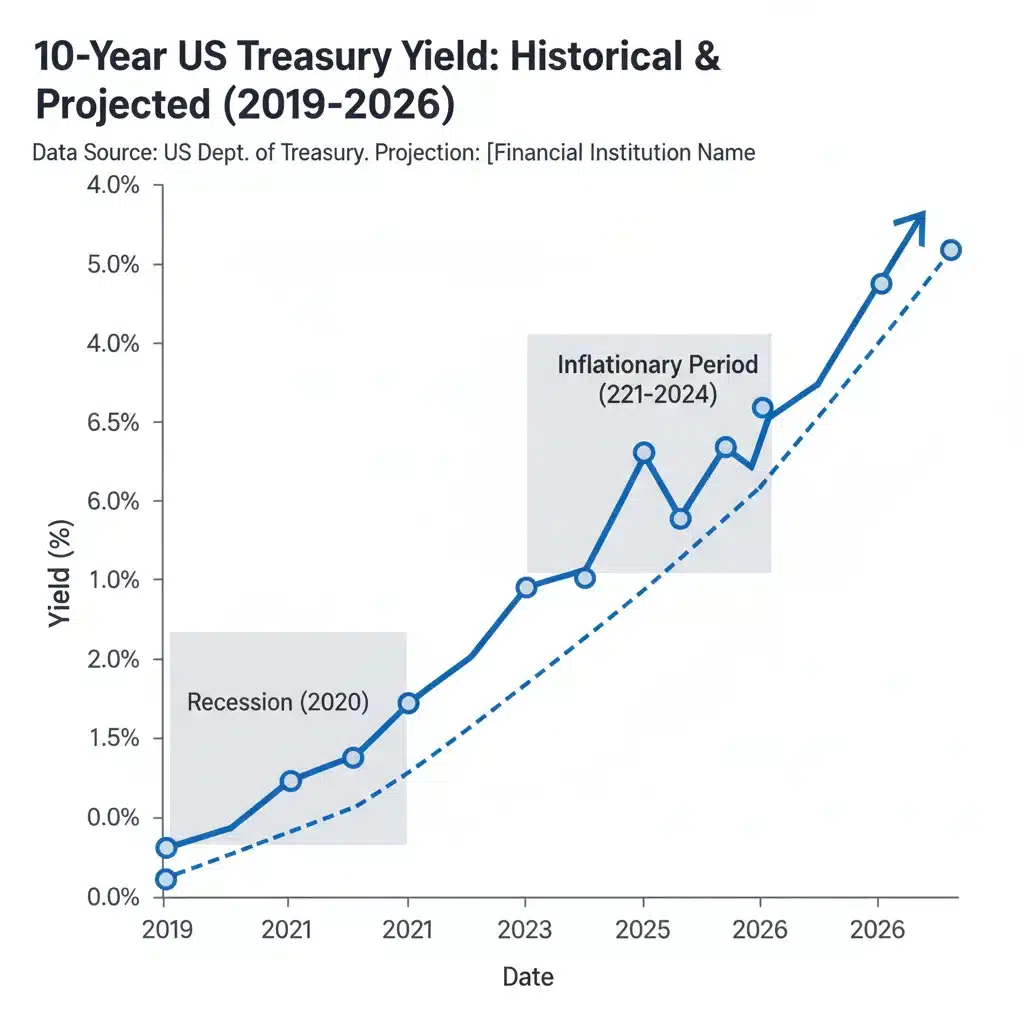
Forecasting Treasury Yields 2026 involves making educated assumptions about the future trajectory of these influencing factors. While no one can predict the future with absolute certainty, economic models and expert consensus can provide valuable insights.
Potential Scenarios for Economic Growth and Inflation
Several scenarios could unfold by 2026. One possibility is a ‘soft landing,’ where inflation gradually recedes without a severe recession. In this scenario, central banks might start to ease monetary policy, leading to a gradual decline in short-term yields, while longer-term yields might remain relatively stable or even rise slightly if economic growth proves robust. Another scenario is a ‘hard landing’ or recession, which would likely lead to more aggressive rate cuts by central banks, causing both short-term and long-term yields to fall significantly as investors seek safety. Conversely, if inflation proves more stubborn than anticipated, central banks might be forced to maintain higher rates for longer, keeping yields elevated.
Central Bank Policy Outlook
The Federal Reserve’s stance will be paramount. Their dual mandate of maximum employment and price stability will continue to guide their decisions. By 2026, the market will have a clearer picture of whether inflation has been tamed and if the economy can sustain growth without excessive stimulus. The consensus view among many economists suggests a potential for rates to stabilize or even begin to decline modestly by 2026, assuming inflation is brought under control. However, the path to that point is likely to be volatile, with market expectations shifting based on incoming economic data.
Long-Term Structural Factors
Beyond cyclical factors, long-term structural trends also influence yields. These include demographic shifts (e.g., an aging population impacting savings rates), technological advancements (affecting productivity and potential growth), and global trade patterns. For instance, increased global savings could put downward pressure on long-term yields, while persistent government deficits could exert upward pressure. These forces evolve slowly but are crucial for understanding the baseline level of yields over the long run.
Impact on Fixed-Income Portfolios
The movement of Treasury Yields 2026 has direct and profound implications for fixed-income investors. Understanding these impacts is the first step toward crafting effective strategies.
Interest Rate Risk and Bond Prices
The inverse relationship between bond yields and bond prices is fundamental. When yields rise, the market value of existing bonds with lower coupon rates falls. This is particularly true for longer-duration bonds, which are more sensitive to interest rate changes. Conversely, when yields fall, bond prices increase. Investors holding existing fixed-income assets must be acutely aware of this interest rate risk, especially in a volatile yield environment. For those looking to invest, higher yields present an opportunity to lock in better returns.
Reinvestment Risk
Reinvestment risk arises when interest rates fall, and investors are forced to reinvest their coupon payments or matured principal at lower rates. While rising yields mitigate reinvestment risk by offering higher returns on new investments, a scenario where rates fall significantly by 2026 could pose a challenge for investors relying on a steady income stream from their fixed-income portfolios. Active management of maturity ladders becomes crucial in such an environment.
Credit Risk and Spreads
Treasury yields serve as a benchmark for other fixed-income securities. Corporate bonds, municipal bonds, and other debt instruments typically offer a spread above comparable Treasury yields to compensate for their additional credit risk. Changes in Treasury yields can influence these spreads. For example, in times of economic stress, credit spreads tend to widen as investors demand greater compensation for taking on credit risk, even if Treasury yields are falling. Monitoring these spreads provides insight into market sentiment regarding credit quality.
Inflation Risk
As mentioned, inflation erodes the real value of fixed payments from bonds. While Treasury Inflation-Protected Securities (TIPS) offer protection against inflation, most conventional bonds do not. If inflation remains elevated or resurges by 2026, the real return on fixed-income investments could be significantly diminished, even if nominal yields appear attractive. Investors must consider the purchasing power of their future income and principal.
Strategic Approaches for Fixed-Income Portfolios in 2026
Given the anticipated dynamics of Treasury Yields 2026, investors need to adopt flexible and diversified strategies. Here are several approaches to consider:
1. Diversification Across the Yield Curve
Instead of concentrating investments at one point on the yield curve, consider spreading maturities across short, intermediate, and long-term bonds. This strategy, known as a ‘barbell’ or ‘ladder’ approach, can help mitigate interest rate risk. A barbell strategy involves investing in very short-term and very long-term bonds, while a ladder strategy involves staggered maturities. This allows for regular reinvestment opportunities at prevailing rates while maintaining some exposure to potentially higher long-term yields.
2. Focus on Shorter Duration Bonds (Flexibility)
If you anticipate continued volatility or a potential for yields to rise further, shorter-duration bonds offer less interest rate sensitivity. While their yields might be lower than long-term bonds, their prices will fluctuate less in response to rate changes. This strategy provides more flexibility to reinvest at higher rates if they materialize, without suffering significant capital losses on existing holdings.
3. Consider Treasury Inflation-Protected Securities (TIPS)
For investors concerned about persistent inflation, TIPS are an invaluable tool. Their principal value adjusts with the Consumer Price Index (CPI), providing a hedge against inflation. While their nominal yields might be lower than conventional Treasuries, their real returns can be more attractive in an inflationary environment. Including TIPS in a diversified fixed-income portfolio can offer crucial protection against the erosion of purchasing power.
4. Explore High-Quality Corporate Bonds and Municipal Bonds
Beyond Treasuries, high-quality corporate bonds (investment grade) and municipal bonds can offer higher yields while maintaining relatively low credit risk. Municipal bonds, in particular, often provide tax-exempt income, which can be highly attractive for investors in higher tax brackets. Careful credit analysis is essential when venturing beyond Treasuries to ensure the additional yield adequately compensates for any incremental credit risk. The spread over Treasuries for these instruments will be crucial to evaluate.
5. Active Management and Tactical Adjustments
In a volatile market, a passive ‘buy and hold’ strategy for fixed income might not be optimal. Active management involves regularly monitoring market conditions, economic data, and central bank communications to make tactical adjustments to the portfolio. This could mean adjusting duration, reallocating between different types of bonds, or taking advantage of temporary mispricings. An actively managed approach allows investors to respond swiftly to changes in Treasury Yields 2026 and capitalize on emerging opportunities.
6. Utilize Fixed-Income ETFs and Mutual Funds
For many investors, accessing a diversified fixed-income portfolio through exchange-traded funds (ETFs) or mutual funds can be efficient. These vehicles offer instant diversification, professional management, and liquidity. There are funds specifically designed to focus on short-duration bonds, TIPS, corporate bonds, or even global bonds, allowing investors to tailor their exposure to their specific outlook and risk tolerance. It’s crucial to understand the fund’s underlying holdings, expense ratios, and management style.
7. International Bond Exposure
While U.S. Treasuries are a cornerstone, diversifying into international bonds can offer additional opportunities and risk reduction. Different countries may be at different stages of their economic cycles and monetary policy tightening, leading to varying yield environments. Currency fluctuations introduce an additional layer of complexity, but hedged international bond funds can mitigate this risk. Global diversification can enhance returns and reduce overall portfolio volatility.

Key Considerations for 2026 and Beyond
As we plan for Treasury Yields 2026, several overarching considerations should guide investment decisions.
Risk Tolerance and Investment Horizon
Every investment strategy must align with an individual’s risk tolerance and investment horizon. Investors with a shorter time horizon might prioritize capital preservation and liquidity, opting for shorter-duration assets. Those with a longer horizon might be able to withstand more volatility and benefit from potentially higher long-term yields. Understanding your personal financial goals and constraints is paramount.
Impact of Quantitative Tightening (QT)
Beyond interest rate hikes, central banks have also engaged in quantitative tightening (QT), reducing the size of their balance sheets by allowing bonds to mature without reinvesting the proceeds. This effectively reduces demand for Treasuries, which can put upward pressure on yields. The pace and duration of QT will be a significant factor influencing bond market liquidity and yield levels heading into 2026.
The Role of Fiscal Policy
Government spending and taxation policies (fiscal policy) also play a crucial role. Large government deficits require more borrowing, increasing the supply of Treasuries. If fiscal policy remains expansionary, it could contribute to higher yields. Conversely, a more fiscally conservative approach could alleviate some of the upward pressure on yields. Investors should monitor government budget projections and legislative developments.
Technological Advancements and Productivity
In the long run, technological advancements and their impact on productivity growth can influence the ‘natural’ rate of interest and, consequently, Treasury yields. Higher productivity can support stronger non-inflationary economic growth, potentially allowing for lower equilibrium interest rates. While this is a longer-term factor, it forms part of the underlying framework for yield expectations.
Conclusion
The landscape for fixed-income investors in the lead-up to 2026 is characterized by both challenges and opportunities, primarily driven by the evolution of Treasury Yields 2026. The era of persistently low yields appears to be behind us, and investors must adapt to a more dynamic and potentially higher-yield environment. By understanding the forces that shape yields – inflation, monetary policy, economic growth, and global events – and by implementing strategic adjustments to their portfolios, investors can navigate these complexities successfully.
Diversification across maturities, a focus on duration management, strategic use of TIPS, and careful selection of credit-worthy non-Treasury bonds are all vital components of a robust fixed-income strategy. Active management and a willingness to adapt to new information will be key. While the path of Treasury yields is never entirely predictable, a well-informed and disciplined approach will empower investors to optimize their fixed-income portfolios for the opportunities and challenges that 2026 and beyond will undoubtedly bring. Staying abreast of economic indicators, central bank communications, and geopolitical developments will be crucial for making timely and effective investment decisions.